I was reading
this post over at Ballastexistenz when the discussion in the comments drifted over to not killing except whenever possible, including invertebrates. Being an insect and arachnid freak myself I pitched in a bit and, after a while, I decided to share here a few tips on how not to needlessly kill our six- and eight-legged friends. What your cat does, however, may be completely out of your control.
Living Peacefully with Spiders:Spiders are almost certainly harmless with the exception of a select few species which are capable of causing us serious or even fatal harm. Of those species which are capable of harming us, very few are territorial enough to pose much of a problem unless we intentionally molest them or do something very careless like reaching into a dark area like a crevasse or under an upturned flower pot without first looking. So, without further ado:
* Make a habit of looking before you place your hand in dark, secluded areas like behind bookshelves, inside empty flower pots, behind the water heater ect... If you find a dangerous spider there and still need to stick your hand in try coaxing it out gently with a stick. If you are able, leave the spider be secure in your knowledge that she is perfectly happy remaining where she is and will not come hunting for you.
* If a child is likely to stick their hand in said location, consider relocating the spider to a place where this is less likely to occur. If the child is old enough, consider teaching them the wisdom of looking before feeling.
* If you see a spider traveling along your walls or otherwise hunting in the open it is almost certainly NOT DANGEROUS! It is also unlikely to build a web, although it may. I almost never interact with spiders I see doing this. The exception is
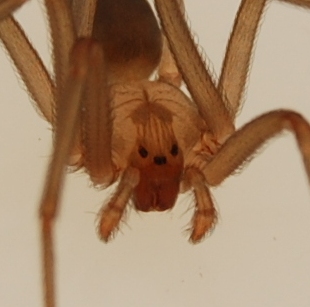
Loxosceles reclusa, also known as the 'brown recluse spider,' which is a roaming spider and does have a necrotic bite but is, like almost all spiders, docile towards humans. (see notes below)
* If you are concerned with spiders in your bed at night, when spiders are most likely to roam, consider moving your bed a couple inches away from the wall. This will dramatically lower the chance of a spider wandering into your bed.
* When handling debris such as wood in wood piles wear work gloves. These will protect your hands from being bitten.
Specific Spiders in North AmericaDisclaimer: The following information on specific spiders is provided to the best of my knowledge and for informational purposes only. Be aware that if you are extremely small of stature, very young, very old, or otherwise very weak spider venom may interact with your system more seriously.
* A special note regarding the brown recluse spider (
Loxosceles reclusa): Please be aware that many people misidentify completely harmless spiders as brown recluse spiders so be sure to make a positive identification before acting. Firstly, be aware that
L. reclusa is ONLY found in the southeastern United States and NOT along the Eastern Seaboard or Florida so if you are not in this region you do not have to worry about this spider. If you are in this region you may make a positive identification by taking a close look at the eyes which, unusually, are six (rather than eight) and are broken into pairings with one pair forward and one pair to each side.
Please reference
this photo which highlights the eye pattern of L. reclusa.
If a spider does not have this eye pattern it is not a brown recluse!Furthermore, the recluse spider is largely harmless in that it does not hunt humans and will only bite us in the most dire of circumstances. Check clothing that has not been handled recently before wearing to ensure that the spider is not pressed against your skin.
For more information on
L. reclusa, including range and detailed identification instructions, visit
this Ohio State website regarding the brown recluse.
* The other medically important spiders in North America are the black widows (
Latrodectus sp.). They make cobwebs in dark, sheltered areas that are rarely disturbed and, because of this, are thus extremely easy to avoid. They are also very reluctant to bite, even when disturbed. I would recommend leaving these spiders alone unless you must disturb their web or a small child is likely to stumble upon them.
Be able to recognize the difference between your local widow species and your local false widow (
Steatoda sp. especially
Steatoda grossa) who's bite is considerably less dangerous for a healthy, normally sized adult yet is still incredibly painful and should not be handled with bare hands.
For more information and pictures check
this Duke University page on widows and compare with
these pictures at BugGuide.net of Steatoda spp.. Please note that, contrary to the Duke page's information, widow spiders may fail to exhibit red markings of any kind and are much more reliably identified by their lack of color variation on their abdomen which is a solid black. Note that some false widows have very subtle patterning that may look black upon first glance, for example my local species which is black with very dark purple patterning.
Handling Spiders:If you must handle a spider there are a few important things to keep in mind. The first is to always remain calm and composed and to avoid, whenever possible, the startle reflex. The second is to move slowly and deliberately while following solid technique.
The most important technique which you need to master is cup-and-lid technique. This is where you have a cup, which you hold horizontally next to the spider, and an implement, usually a lid but it can also be a card and hobbyists often use a small paintbrush, which you use to very gently brush the legs of the animal to steer it into the cup. Once the animal is in the cup, of course, you apply the lid, being careful not to crush any protruding legs, and transport the animal to wherever the spider needs to be transported to.
An alternate method, which is much less advisable, is to place a cup over the spider with a piece of card next to it and to scoot the cup gently over the card until the animal is trapped inside the cup on the card. This risks injuring the spider's legs, however, as they have very tiny claws which may not release easily from the spider's substrate.
A spider is extremely unlikely to bite skin which it is standing on provided that it is not trapped underneath clothing. I often heard a spider onto my hand (place your hand flat against the ground and allow the spider to walk onto it) when a cup is not readily available (usually because one of my fellow humans is threatening to kill it). Once on my hand they tend to like to wander so proper technique is to place your alternate hand flat in front of its path so that it will climb onto your other hand on its own volition: If the spider is going to walk off the edge of your hand place your other hand edge-to-edge with your current hand and if the spider is walking up your arm just place your hand over your wrist. "Walk" your hands this way until you reach a place where you wish to unload the spider and then allow it to peacefully walk off your hand.
Recognize a spider's threat posture which consists of raising both front legs (and sometimes all four front legs) in the air while baring fangs and rearing up. I found
a wonderful picture of a threat posture here. The spider will adopt this posture very quickly and will shift its posture rearwards (although will not step). Be able to distinguish this from a spider stepping or feeling with both front legs which they sometimes do: This will typically be a much slower motion and will be more deliberate. Interestingly, although you will never encounter this in human/spider interaction, a female mating posture is extremely similar.
A spider that is threatened in its web will often vibrate rapidly as a threat display.
New World tarantulas will typically face directly away from an attacker and kick their abdomen to release a cloud of irritating hairs which can be quite nasty. While you will almost certainly never find a tarantula in your home, if you are lucky enough to encounter such a creature avoid allowing your face to get too close to them and do not rub your eyes after being 'flicked' by or after touching them (don't touch wild animals).
Relocating SpidersWhen choosing a location to relocate a spider to try to find a location similar to that which you found them. In other words, if you found a widow spider underneath a flower pot, consider moving it to underneath another which you are not in need of.
Do not, under any circumstances, move a spider directly from a heated house to outside especially during the winter or when nighttime temperatures are cold! The spider likely relies on the controlled temperature inside the house to survive and
moving them outside will likely kill them. Consider moving a spider found, for example, in the bedroom into the living room or kitchen or, if they can not be allowed to remain in the house at all, into the garage which is at least not as cold as the outside. At the very least place them in a sheltered location such as under a flower pot.
Loving Thine Neighbor the Cockroach:The best way to handle cockroaches is to not present them with a habitat that they thrive in. In other words, keep things tidy, especially under the sink and around food stores. Do not store food (except possibly in cans) in locations which are damp or particularly humid. Ensure that uncanned food, especially flour or other grains are kept in sealed containers (or properly resealed bags) or in the refrigerator. Don't store grains for long periods of time and keep cereal high up, preferably in an exposed location such as on top of the fridge.
Use garbage cans with lids on them whenever possible. If you must use a can without a lid choose a garbage can with as smooth an exterior as possible to impair climbing by all but the most agile of species.
Do your best to keep under the sink, especially under the kitchen sink, as dry as possibly by ensuring that the drain is in proper working order. If you have the option, under the sink is likely not the best location for the trash. If roaches have been a problem in the past, consider applying a lid to your under-the-sink garbage can during the night and when food is not being prepared.
Keep food, especially carbohydrates such as cereals, grains, and sugars, higher off the ground and reserve lower cupboards for non-food items or canned items.
Never place food other than canned or jarred food in a pantry without first placing them in sealed containers or tupperware containers. Try not to ever store grains or cereals in the pantry or basement but, if you must, locate these options as high up as possible and never on the floor.
Finally, if you find a cockroach in your house or in your garage don't panic! Especially if the animal was found in the garage, basement, or pantry (with canned foods) it is likely that this animal is not of a species that thrives in a domestic environment. Try to identify the animal as best you can to see if they are a German cockroach (
Blattella germanica) or a
Periplantia species which includes the American cockroach (
Periplantia americana) in which case they are almost certainly a problem. Other species, however, either do not or are reluctant home invaders and are usually not a problem even if they are present in low numbers in the basement or garage. Remember, you should not be storing food in these locations outside of cans or sealed containers and more vulnerable food (like unopened cake mix) should be stored as high up as possible!
Blatta orientalis, also known as the oriental cockroach, is also a known home-invader but my experience with them is that they rarely invade the home-proper and usually just hang out in garages or basements.
Check out
this picture showing the difference between four different roach species. The image also includes
Supella longipalpa aka. 'banded cockroach' of which I have no experience but apparently is a common home invader. Compare with
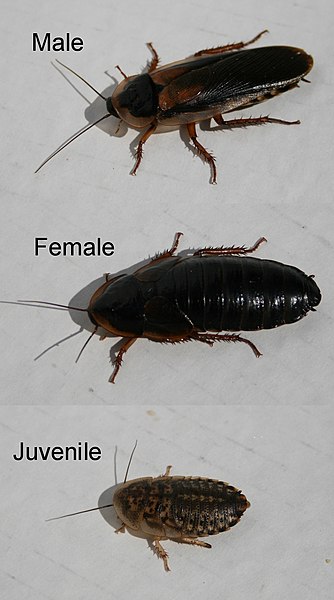
this image of Blaptica dubia, a noninvasive species which is routinely domesticated (including by me).
~~
Anyway, that's pretty much all I can think of right now. If you have any questions, comments, suggestions, or corrections please leave a comment and I'll try to answer them or update my info as appropriate.